
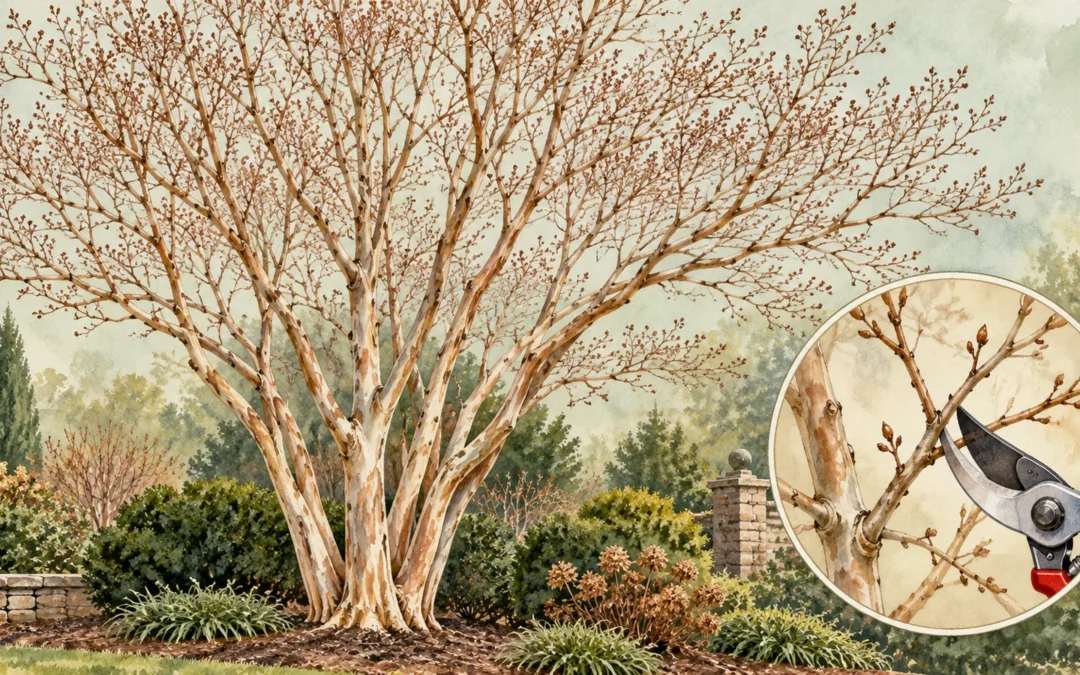
Illustration of natural crape myrtle form and selective pruning, not a precise cutting diagram.
Prune crape myrtles selectively in late winter or early spring, removing dead, broken, rubbing, or obstructing branches while preserving the natural framework. Avoid topping, and remember that a healthy plant with enough room may need little or no annual pruning.
A crape myrtle doesn’t need a yearly haircut just because the neighbors are pruning theirs. Before you pick up the loppers, step back and ask: What am I trying to fix?
A rubbing branch, a broken limb, or growth blocking a walkway gives you a reason to prune. A healthy plant with room to grow may need very little attention. The goal is a good-looking plant you can enjoy, not another annual project.
When should you prune?
For routine shaping, aim for late winter or early spring while the plant is dormant, before new growth starts. Crape myrtles flower on the current season’s growth, but they do not have to be pruned to bloom.
Avoid making heavy pruning part of your fall cleanup. Pruning can encourage growth when the plant should be preparing for winter. The right calendar date varies by climate, so don’t treat one February weekend as a nationwide deadline. Follow your local Extension office’s seasonal guidance. University of Georgia: Crape Myrtle Culture
Clearly broken or hazardous branches are a separate issue from routine shaping. Address safety problems promptly, with professional help when needed.
Start with the plant’s natural size and shape
Crape myrtles include compact shrubs and substantial trees. A dwarf variety doesn’t need to be trained into a miniature version of a large, multi-trunk tree. Likewise, a tall-growing variety won’t become a naturally compact shrub because its top gets cut off every winter.
If your crape myrtle repeatedly crowds a window, roof, or driveway, compare its expected mature size with the space available. Selective pruning may provide clearance, but replacing an unsuitable plant with a smaller cultivar can reduce years of maintenance. Clemson Extension: Crape Myrtle
Make a short pruning plan
Walk around the plant before cutting. Look for:
- Dead or broken branches.
- Branches rubbing against one another.
- A small number of crowded or inward-growing shoots.
- Unwanted shoots at the base, if you are maintaining a tree form.
- Specific branches interfering with access.
For crossing branches, choose the one whose removal best preserves the plant’s shape. Don’t strip every small twig from the canopy or remove all the lower growth simply because you can. If you prefer a shrub form, basal growth may belong in that design. Clemson Extension: Crape Myrtle Pruning
Mark questionable branches with loose, temporary ribbon before starting. Then look again from the house or driveway. That extra minute is easier than trying to put a branch back.
Use clean tools and careful cuts
Sharp hand pruners suit small shoots; loppers or a pruning saw handle larger wood within their rated capacity. Don’t force a tool through a branch it cannot cut cleanly.
Remove dirt and plant residue from blades. Clean and disinfect tools between plants, especially after working on diseased material. University of Minnesota Extension recommends 70% isopropyl alcohol for suitable hand tools; follow safe handling instructions and keep it away from flames. Tool-cleaning guidance
When removing a branch, preserve the branch collar, the slightly swollen area where it joins the trunk or larger limb. Don’t leave a long stub or cut flush into the trunk. Keep homeowner pruning to manageable branches reachable from the ground. Large limbs, overhead work, and branches near utilities belong with qualified professionals. Texas A&M: Proper Pruning Techniques
Skip the flat-top haircut
Cutting every trunk or major branch back to the same height is topping, often called “crape murder.” It removes the natural framework and can produce vigorous, weakly attached regrowth. A plant surviving that treatment does not make it good routine care. Texas A&M recommends selective thinning rather than topping. Pruning guidance
For a previously topped tree, don’t assume another hard cut is the solution. A local arborist can help you choose between gradual restoration and replacement.
Wait before judging freeze damage
After a hard freeze, bare branches alone don’t tell you what survived. Wait for spring growth to reveal living sections before removing suspected cold-damaged wood, unless there is an immediate hazard. Then remove confirmed dead growth appropriately. Timing varies with the plant and local weather; a fixed nationwide deadline isn’t useful. Alabama Extension: Cold Injury
Quick questions
Do I need to remove old seed heads?
No. It’s optional when they are easy to reach. Don’t climb a ladder just to remove them; crape myrtles can bloom without that cleanup. Clemson pruning guide
Should I cut a newly planted tree back hard?
Generally, no. Remove broken or damaged branches rather than automatically reducing the top at planting. Texas A&M pruning guide
How much should I prune every year?
There is no required annual amount. If you cannot name a problem a cut will solve, leave that branch alone.
Choosing the right variety makes this easier from the beginning. When comparing Crape Myrtle Guy plants, consider mature height and width alongside flower color, then give your selection room to grow.
Learn more about Clint Cotten, the grower behind Crape Myrtle Guy.

